
How to Rank Your Business in Multiple Local Areas: A Simple Step-by-Step Guide
By the Bizzdose Team | Digital Marketing Company in Lalpur, Varanasi
You have one shop, one office or one service team, but your customers are spread across many mohallas, towns and cities. Maybe you run a coaching centre in Varanasi and students come from Mughalsarai, Ramnagar and Sarnath. Maybe you offer AC repair, interior design or digital services, and you want calls from Jaunpur, Mirzapur, Bhadohi and Ghazipur too. The big question is how to rank your business in multiple local areas without spending lakhs on ads every month.
The good news is that it is possible. It takes planning, patience and the right local SEO steps, but you do not need a big budget or a big-city address to do it. We at Bizzdose work with small and mid-size businesses every day, and this guide shares the same method we follow for our own clients, explained in simple language.
By the end of this article you will know:
- What local ranking in many areas really means
- Which Google tools and settings matter the most
- A clear step-by-step process you can follow
- The common mistakes that push businesses down in search results
- How much it may cost and how long it can take
Read it slowly, note the points that apply to your business, and if you get stuck, our team in Lalpur is always a call away.
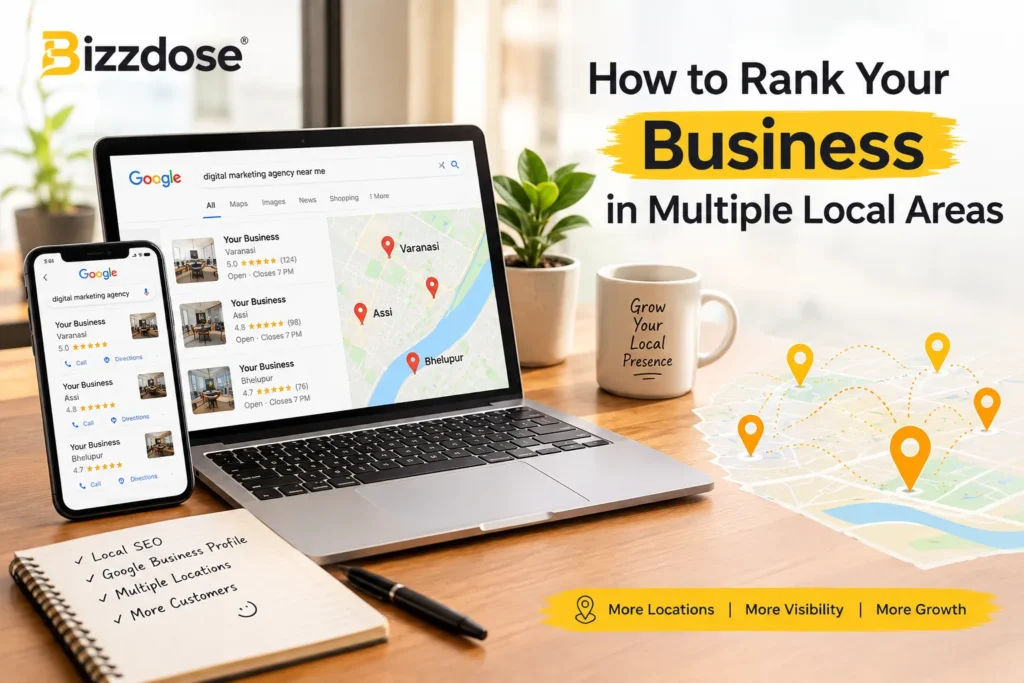
How to Rank Your Business in Multiple Local Areas: Quick Answer
If you are in a hurry, here is the short version. To rank a business in many local areas, you need to do these things in order:
- Set up and verify your Google Business Profile with correct name, address, phone number and categories.
- Decide which areas you really serve and list them honestly as service areas or as separate branch locations.
- Create one useful, unique page on your website for each area, with real local details.
- Keep your name, address and phone number (NAP) same across all online directories.
- Collect genuine customer reviews that mention the service and the area.
- Build local links, mentions and citations from websites people in that area actually trust.
- Track rankings area by area and improve every month.
That is the whole idea in seven lines. The rest of this guide explains each point in detail so you can actually do it.
What Does Ranking in Multiple Local Areas Really Mean?
When someone searches “best digital marketing company near me” or “AC repair in Ramnagar”, Google shows a map with three businesses and then normal website results below it. Ranking locally means appearing in that map pack (also called the local pack) and in the regular results for the right area.
Ranking in multiple areas means you want to appear for many such searches, in many places, not just the place where your office is located. This is where most business owners get confused, because Google gives the most weight to businesses that are physically close to the person searching.
Single Location vs Multi-Location Businesses
There are two common situations, and the strategy is different for each.
Business with one office, many service areas
This is a service-area business. You go to the customer, or you serve customers from one place. Examples are plumbers, electricians, packers and movers, home tutors, event planners and digital agencies. Your Google Business Profile can show the areas you serve, and your website can have separate pages for each area.
Business with many real branches
This is a multi-location business. You have actual shops, clinics, showrooms or offices in different places. Each branch should have its own Google Business Profile, its own phone number and its own location page on the website.
Knowing which type you are is the first step in learning how to rank your business in multiple local areas the right way. Mixing these up is one of the most common reasons people lose rankings or even get their listing suspended.
Understanding Search Intent Behind Local Searches
People who search with a place name usually want to buy or visit soon. They are not reading for fun. They want a phone number, a map, timings, prices and proof that you are trustworthy. So your pages must answer these quickly:
- What do you offer?
- Do you serve my area?
- How can I contact you right now?
- Can I trust you? (reviews, photos, past work)
If your page answers these four things clearly, Google understands that your page is helpful and users stay longer instead of pressing the back button.
Why Ranking in Multiple Local Areas Is Important for Your Business
Many owners in tier 2 and tier 3 cities think, “My customers already know me, so why do I need this?” The truth is that today even people living two streets away check Google before they call. And people from nearby towns have no other way to find you.
More Customers Without Higher Rent
Opening a new branch costs a lot in rent, staff and setup. Ranking in nearby areas online lets you reach new customers from the same office. You pay for good content and optimisation, not for extra shop space.
High-Intent Customers Who Are Ready to Buy
Local searchers are often close to a buying decision. Someone searching “wedding photographer in Mirzapur” is not browsing; they are planning a booking. Ranking in many areas puts you in front of many such ready customers at the same time.
Stronger Trust and Brand Recall
When your name appears again and again in different local searches, people start recognising it. That repeated visibility builds trust, and trust is what makes someone call you instead of a competitor.
Lower Cost Than Ads in the Long Run
Paid ads stop the moment you stop paying. Local SEO takes time to build, but once your pages and profiles are strong, they keep bringing enquiries month after month at a much lower cost per lead.
Beating Bigger Competitors on Local Turf
A national company cannot know the lanes, landmarks and local needs of Lalpur or Sigra the way you do. Good local SEO lets you use that knowledge as an advantage and win against bigger brands.
About Bizzdose: Your Local Digital Marketing Partner in Varanasi
Bizzdose is a digital marketing company based in Varanasi, Uttar Pradesh. We help local businesses get found on Google, get more calls and WhatsApp enquiries, and turn online visitors into real customers. Our services include local SEO, website design and development, Google Business Profile management, social media marketing, content writing and paid advertising.
We work mostly with small and growing businesses, the kind of owners who want clear answers, honest reports and results they can see in their phone. We do not use big jargon or confusing reports. If something is not working, we say it openly and fix it.
Our office address: Bizzdose, Sector-B, JP Complex, Lalpur, Varanasi, Uttar Pradesh 221002
Phone / WhatsApp: +91 84236 81741
Website: https://bizzdose.com/
Being in Varanasi means we understand how customers in Purvanchal search, speak and decide. Many people here type in Hinglish, use local place names and trust reviews and word of mouth. Our strategies are built around that reality, not copied from foreign blogs.
Why Choose Bizzdose for Multi-Location Local SEO?
There are many agencies promising “rank 1 in 7 days”. Honestly, no one can promise that. Here is what you can actually expect from us:
- Honest advice: If your business does not need a service, we will not sell it to you.
- Local understanding: We know the markets and customer habits of Varanasi and nearby districts.
- Simple communication: Updates in easy Hindi or English, on call or WhatsApp, without technical overload.
- White-hat methods only: No fake reviews, no fake addresses, no spam links. These tricks may work for a month, then Google punishes them.
- Clear reporting: You see what we did, what changed and what we will do next.
- Flexible plans: A tea shop and a hospital do not need the same plan, so we customise.
Our Unique Selling Points
1. Area-wise strategy, not copy-paste
Most agencies create 20 pages with only the city name changed. Google calls this doorway content and it can hurt you. We write each area page with real local details, such as nearby landmarks, local customer questions and area-specific offers.
2. Profile safety first
Google Business Profile suspensions can stop your calls overnight. We follow Google’s guidelines carefully so your listing stays safe.
3. Review growth system
We set up an easy way, like a short link or QR code, so happy customers can leave reviews without any trouble.
4. Mobile-first, speed-first websites
Most local searches happen on phones, often on average internet speed. We build light, fast pages with click-to-call and WhatsApp buttons.
5. Monthly improvement, not one-time work
Local SEO is not a one-day job. We keep checking, updating and improving every month.
Step-by-Step Process: How to Rank Your Business in Multiple Local Areas
This is the heart of the guide. Follow these steps in order. Whether you do it yourself or take help from an agency like Bizzdose, the process stays the same.
Step 1: Do a Local SEO Audit of Your Current Position
Before you start, find out where you stand today.
What to check
- Does your Google Business Profile exist, and is it verified?
- Is your business name, address and phone number the same everywhere?
- Does your website load fast on mobile?
- Which areas already send you customers?
- Who are the top three competitors in each area?
Simple way to check rankings
Open an incognito window on your phone and search your service with the area name, for example “digital marketing agency in Lalpur”. Note where you appear. Repeat for each area. This simple sheet becomes your starting report.
Step 2: Choose Your Target Areas Wisely
Do not pick 50 areas on day one. Start with the places that make business sense.
How to select areas
- Areas where you already get customers
- Areas within a practical travel or service distance
- Areas with good search demand but weaker competition
- Areas where your customer’s average spending matches your pricing
A good starting list is 5 to 10 areas. Once those start performing, expand to more.
Step 3: Optimise Your Google Business Profile
Your Google Business Profile (earlier called Google My Business) is the single most powerful tool for local visibility. Treat it seriously.
Business name, address and phone
Use your real business name exactly as it appears on your board. Do not add keywords or area names to the name, because that is against Google’s rules and can lead to suspension. Use a local phone number that you actually answer.
Primary and secondary categories
Choose the category that best describes your main service as the primary one. Add secondary categories for other services. This helps Google match you to the right searches.
Service areas for service-area businesses
If you travel to customers, add the areas you serve in your profile. Google allows up to 20 service areas, so choose the most important ones. If customers do not visit your location, you can hide your address as per Google’s guidelines.
Separate profiles for real branches
If you have genuine branches with staff and signage, create a separate profile for each. Never create profiles with fake addresses, virtual offices or someone else’s shop. This is the fastest way to get suspended.
Photos, posts and Q&A
Upload real photos of your shop, team and work. Post updates and offers every week. Add common questions and answers in the Q&A section. An active profile tells Google you are a live, trusted business.
Step 4: Build a Strong Website Structure for Many Areas
Your website supports your Google profile. It should clearly tell Google what you do and where you do it.
Create a main service page
Build one detailed page for each main service. For example: Local SEO, Website Design, Social Media Marketing.
Create separate location pages
For each important area, create one page. Do this only if you truly serve that area. A good location page includes:
- A clear heading with service and area name
- Who you are and how you serve that area
- Services available there
- Local landmarks or nearby places customers will recognise
- Real photos or work done in that area
- Customer reviews from that area, if you have them
- Map, phone number and WhatsApp button
- A short FAQ for that area
Avoid duplicate content
This is where most websites fail. If 10 pages have the same text with only the area name changed, Google may ignore them all. Each page must have mostly unique, useful content. Write about real problems of that area. For example, a page for a Ramnagar customer can talk about travel time from Varanasi and how you manage visits.
Step 5: Fix On-Page SEO for Every Page
On-page SEO means helping Google understand each page clearly.
- Title tag: Include service and area, keep it around 60 characters.
- Meta description: Write a helpful 150 to 160 character summary with a reason to click.
- URL: Keep it short and readable, like /seo-services-ramnagar/.
- Headings: Use one H1 and organise the rest with H2 and H3.
- Image names and ALT text: Describe the image honestly.
- Internal links: Link area pages to the main service page and back.
Use your keyword naturally. Write for the reader first. If a sentence sounds odd when read aloud, rewrite it.
Step 6: Keep Your NAP Consistent With Local Citations
A citation is any place online that lists your business name, address and phone number. Examples are JustDial, Sulekha, IndiaMART, Facebook and local business directories.
Why consistency matters
If one site says “JP Complex, Lalpur” and another says “J.P. Complex, Sector B”, Google may get confused about which one is correct. Small differences can weaken trust.
How to do it
- Decide one standard format for your name, address and phone number.
- Update all existing listings to match.
- Add your business to quality Indian and local directories.
- Remove or merge duplicate listings.
Quality matters more than quantity. Ten correct listings are better than a hundred messy ones.
Step 7: Get Genuine Reviews From Each Area
Reviews are one of the strongest local ranking signals, and they also decide whether a customer picks you or the next listing.
How to get more reviews the right way
- Ask happy customers right after the work is done
- Share a direct review link through WhatsApp
- Put a QR code on your invoice or counter
- Say thank you to every reviewer
- Reply politely to negative reviews and offer to solve the issue
What not to do
Never buy reviews, never write reviews yourself, and never offer money for positive ratings. Google can remove them and may penalise your profile.
Step 8: Build Local Links and Mentions
Links from trusted local websites tell Google that real people and businesses vouch for you.
Easy local link ideas
- Local news websites and city portals
- Business associations, chambers of commerce and trade groups
- Event sponsorships, college fests and charity drives
- Partnerships with related, non-competing businesses
- Guest articles on local blogs
- Your own supplier and client websites
One good link from a respected local source is worth more than fifty links from random spam sites.
Step 9: Create Local Content That Customers Actually Need
Blogs and guides help you rank for many more searches, and they show your expertise. Think about real questions your customers ask and answer them with local flavour.
Content ideas that work
- “How much does [service] cost in Varanasi?”
- “Things to check before hiring a [service provider] in Ghazipur”
- Local success stories and customer interviews
- Festival or season-based offers, for example around Dev Deepawali, Diwali or wedding season
- Short videos for YouTube and Instagram showing your work on site
Add these blogs to your area pages through internal links so Google can see how everything connects.
Step 10: Track, Measure and Improve Every Month
What you do not measure, you cannot improve.
Numbers worth tracking
- Ranking for each service and area combination
- Calls, direction requests and website clicks from Google Business Profile
- Organic traffic to each area page
- Number of new reviews and average rating
- Enquiries and actual sales from each area
Check these every month. Double down on areas that grow, and improve content in areas that are stuck.
Our Detailed Digital Marketing Services for Local Growth
If you do not have time to manage all this yourself, our team can handle it. Here are the services that help businesses understand how to rank their business in multiple local areas and get real results.
Local SEO Services
We audit your presence, fix your Google Business Profile, build area pages, clean your citations and track your rankings. This is our core service for service businesses, shops, clinics, schools and agencies.
Google Business Profile Management
Profile setup, verification help, category selection, regular posting, photo updates, Q&A handling and review management. We also help recover or appeal suspended profiles wherever it is possible.
Website Design and Development
Fast, mobile-friendly and easy-to-edit websites built on WordPress and other platforms. Every site comes with clear calls to action, click-to-call buttons and SEO-ready structure.
Content Writing and Blogging
Human-written blogs, service pages and area pages in simple English or Hindi that your customers understand and Google respects.
Social Media Marketing
Facebook, Instagram and YouTube management with local targeting, reels, offers and community building.
Google Ads and Local Campaigns
For businesses that need quick leads while SEO is building, we run targeted search and local campaigns with proper budget control.
Online Reputation Management
We help you collect more genuine reviews, respond professionally and handle negative feedback calmly.
WhatsApp and Lead Follow-Up Setup
More enquiries are useless if nobody follows up. We help you set up WhatsApp Business, quick replies and simple lead tracking so no customer is lost.
Industries We Serve
Our local SEO approach works for any business that depends on customers from a particular area. We regularly work with:
- Education: Coaching centres, schools, colleges and skill institutes
- Healthcare: Clinics, dentists, diagnostic labs, ayurvedic centres and hospitals
- Home services: Electricians, plumbers, AC repair, pest control, cleaning services
- Real estate and construction: Builders, property dealers, interior designers
- Hospitality and travel: Hotels, guest houses, taxi services, tour operators, travel agents
- Retail and showrooms: Furniture, electronics, jewellery, clothing and Banarasi saree stores
- Wedding and events: Photographers, caterers, decorators, event planners
- Professional services: Lawyers, CAs, consultants, insurance and finance advisors
- Restaurants and cafes: Local food outlets and cloud kitchens
Varanasi’s tourism, textile and education economy gives many opportunities for local brands, and we know how to use them online.
Benefits of Local SEO in Many Areas for Your Customers and Your Business
When you learn and apply how to rank your business in multiple local areas, the benefits go beyond just more traffic.
- More phone calls and walk-ins: Searchers find your number and directions in a few seconds.
- Lower marketing cost: Organic leads cost much less than daily ad spending.
- Better quality leads: People searching for a specific service in a specific place are serious buyers.
- Stronger trust: Reviews, photos and active profiles prove your business is real.
- Long-term growth: Rankings built carefully stay with you for months and years.
- Competitive edge: Many local competitors still ignore SEO, so you can move ahead quickly.
- Better customer experience: Customers get exactly the information they need on their phone.
Tools and Technologies We Use
Tools do not replace experience, but the right tools save time and give accurate data. We commonly use:
- Google Business Profile: For listing management, insights and posting
- Google Search Console: To see which searches bring visitors and fix technical issues
- Google Analytics 4: To track visitors, behaviour and conversions
- Google Looker Studio: For clear, easy monthly reports
- Local rank tracking tools: To check area-wise rankings, such as grid-based trackers
- Keyword research tools: Google Keyword Planner and similar platforms for search demand
- Rank Math and Yoast SEO: For WordPress on-page optimisation
- PageSpeed Insights: To check and improve speed on mobile
- Review request tools: QR codes, short links and WhatsApp templates
- Citation management tools: To find and fix duplicate or wrong listings
Tools only give data. The real value is in reading that data correctly and taking the right action.
Pricing Factors: What Decides the Cost of Multi-Area Local SEO?
Many people ask, “How much will this cost?” The honest answer is that it depends. Every business is different, and anyone quoting a fixed price without understanding your business is guessing. These are the main factors that decide the cost:
- Number of areas: Ten areas need more pages, more content and more tracking than three.
- Number of services: More services mean more pages and keywords.
- Competition level: A crowded market like real estate or coaching needs more effort than a niche service.
- Current website and profile condition: Fixing a broken website costs more than improving a good one.
- Content volume and quality: Original writing, photos and video take time and skill.
- Number of branches: Each branch needs its own profile and management.
- Review and reputation work: Businesses with poor ratings may need extra effort.
- Ad budget: If you also want Google Ads, this is a separate budget.
- Reporting and support level: Weekly calls, dedicated support and custom reports can change the price.
We give a clear, written quote after understanding your business. There are no hidden charges, and you can start small and grow.
How Long Does It Take to See Results?
For most businesses, early movement like better profile views and calls can start within 1 to 3 months. Stronger and stable rankings in multiple areas usually take 4 to 8 months, depending on competition and how much work is done. Be careful of anyone promising first-page results in a few days.
Common Mistakes People Make While Trying to Rank in Many Areas
We see these mistakes again and again. Avoid them and you will already be ahead of most competitors.
1. Creating Fake Addresses or Virtual Offices
Some people add random addresses just to appear in more locations. Google can detect this, suspend your profile and even remove your listing. Only list places where you really operate.
2. Copying the Same Page for Every Area
Changing only the city name on 30 pages is lazy and risky. Each page should offer something unique and useful.
3. Stuffing Area Names Everywhere
Writing “best plumber in Varanasi, plumber in Ramnagar, plumber in Sarnath” in every paragraph looks spammy. Write naturally, like talking to a customer.
4. Adding Keywords to the Business Name
Changing your Google profile name to “Bizzdose Best SEO Company Varanasi” violates the rules and can get you suspended.
5. Ignoring Reviews
Not asking for reviews, or not replying to them, tells customers and Google that nobody is paying attention.
6. Inconsistent NAP Details
Different phone numbers or address formats on different sites weaken your local trust.
7. Slow, Non-Mobile Websites
If your page takes more than three seconds to load on a phone, many visitors leave before seeing anything.
8. Targeting Too Many Areas Too Early
Trying to rank everywhere at once spreads your effort thin. Start with a few areas, win there and then expand.
9. Expecting Instant Results
Local SEO is a steady process. Stopping after one month because “nothing happened” wastes all the earlier effort.
10. Not Tracking Anything
If you do not know which area gives you calls, you cannot decide where to invest next.
Why Bizzdose Is Better Than Typical Competitors
We respect every agency in the market, but here is an honest comparison of what you usually get with a typical agency and what you get with Bizzdose.
| Point | Typical Agency | Bizzdose |
|---|---|---|
| Strategy | Same package for everyone | Custom plan for your business and areas |
| Area pages | Copy-paste with city name changed | Unique, useful content for each area |
| Promises | “Rank 1 in 7 days” | Honest timelines and realistic goals |
| Methods | Sometimes shortcuts and fake listings | White-hat methods only |
| Communication | Technical language, slow replies | Simple language, call and WhatsApp support |
| Reporting | Confusing screenshots | Clear monthly reports with next steps |
| Local knowledge | Limited | Based in Varanasi, knows Purvanchal customers |
| Contract | Long lock-in | Flexible and transparent terms |
Real-World Examples of Multi-Area Local Ranking
These examples show how the same ideas work in everyday businesses. They are simplified illustrations based on common situations, not claims about any specific customer’s results.
Example 1: A Home Tutor Service Serving Several Localities
A tutor service based in one part of the city wanted students from nearby colleges and colonies. Instead of making one generic page, they created pages for each locality with details like preferred timings, subjects and student feedback from that area. They also asked parents for reviews mentioning the subject taught. Over a few months, enquiries from outside their home locality grew steadily.
Example 2: An AC Repair Business Covering a District
An AC repair shop served the city and surrounding towns. They set up their service areas in Google Business Profile, wrote area pages explaining response time and summer demand, and uploaded real before-and-after photos. Because people could clearly see that the business serviced their town, calls from nearby towns increased.
Example 3: A Clinic With Two Real Branches
A clinic with two branches created a separate Google profile for each, with its own phone number, timings and doctor list. Each branch had its own page on the website. Patients stopped getting confused about which branch to visit, and map directions to both branches improved.
Case Studies: How a Step-by-Step Local Plan Works
The following case studies are generic examples built from typical results businesses see when they follow a structured plan. Actual results will vary by industry, competition and effort.
Case Study 1: Coaching Institute Expanding Beyond Its Own Locality
Challenge: A coaching institute got students only from its own neighbourhood. Its website had one page with all courses and no area targeting.
What was done:
- Cleaned and verified the Google Business Profile
- Created separate course pages and area pages for the key surrounding localities
- Added student reviews and results with permission
- Built local mentions through education portals
Typical outcome: Over several months, the institute starts appearing for course-plus-area searches, receives more calls and gets admissions enquiries from areas it never reached before.
Case Study 2: Wedding Photographer Reaching Nearby Cities
Challenge: A photographer was well known in one city but invisible in nearby towns.
What was done:
- Built portfolio pages for each city with real wedding galleries
- Collected reviews from couples across those towns
- Posted photos and short reels regularly
- Improved website speed for mobile users
Typical outcome: More booking enquiries from nearby cities, with clients saying they found the photographer through Google and Instagram.
Customer-Focused Solutions: What Makes Our Approach Different
Every business owner has a different worry. Some want more calls, some want better reviews and some just want to understand what is happening. Our solutions are built around the customer, not the agency’s convenience.
- If you are new to digital marketing, we start with basics and explain everything in simple words.
- If you have a small budget, we focus on the few actions that bring the most return first.
- If you already have a website, we improve it instead of forcing you to rebuild.
- If your profile was suspended, we study the reason and guide you through the correct appeal process.
- If you have many branches, we create a clear, scalable system so each location gets proper attention.
The goal is simple: you should always know what is being done for your business and why.
Frequently Asked Questions About Ranking in Multiple Local Areas
1. How can I rank my business in multiple local areas?
Create and verify your Google Business Profile, define your real service areas, build unique location pages, keep your business details consistent online, collect genuine reviews and earn local links. Then track results monthly and improve.
2. Can one Google Business Profile rank in many cities?
One profile ranks best near its physical location. Service-area businesses can list up to 20 service areas, but ranking far from your actual address is harder. Strong website pages, reviews and local content help you reach farther.
3. Should I create a separate page for each area?
Yes, if you truly serve that area and can write something useful for it. Each page should have unique content, local details, reviews or examples and a clear contact option. Do not create empty or copied pages.
4. Is it okay to add different addresses for different areas?
Only if you genuinely have a staffed branch there. Fake addresses, virtual offices or shared addresses used to trick Google can lead to profile suspension.
5. How long does it take to rank in multiple local areas?
Early improvement can show in 1 to 3 months. Strong rankings in several areas usually take 4 to 8 months or more, depending on competition, budget and consistency.
6. How many areas should I target at the start?
Start with 5 to 10 areas that matter most for your business. Once they perform well, add more gradually.
7. Do reviews help in local ranking?
Yes. Quantity, quality, recency and the words customers use all matter. Reviews also help people trust you enough to call.
8. What is NAP and why is it important?
NAP means Name, Address and Phone number. If these details are consistent across your website, Google profile and directories, Google can trust your business information more easily.
9. Is local SEO better than Google Ads?
They work differently. Ads give quick results but stop when the budget ends. Local SEO takes longer but brings steady leads at a lower cost over time. Many businesses use both together.
10. How much does local SEO cost for multiple areas?
The cost depends on the number of areas, services, competition and the work needed. You can contact Bizzdose for a clear quote based on your business.
Conclusion: Start Small, Stay Consistent and Grow Area by Area
Now you know how to rank your business in multiple local areas. It is not magic, and it is not about tricks. It is about showing Google and your customers that you are real, helpful and active in each place you serve.
To recap the main steps:
- Audit your current position
- Choose the right target areas
- Optimise your Google Business Profile
- Build unique area pages on a fast website
- Keep your business details consistent everywhere
- Collect genuine reviews
- Earn local links and write useful local content
- Track results and improve every month
Businesses that stay patient and honest usually win in local search, even against bigger names. You do not have to do everything alone. If you want an expert team to handle it, Bizzdose is ready to help.
Call to Action: Talk to Bizzdose Today
Ready to get more customers from every area you serve? Let us look at your business and build a clear, practical plan.
Bizzdose Sector-B, JP Complex, Lalpur, Varanasi, Uttar Pradesh 221002 Call / WhatsApp: +91 84236 81741 Website: https://bizzdose.com/
Message us today for a free local SEO consultation, and let us help you reach customers in every area you want to grow.