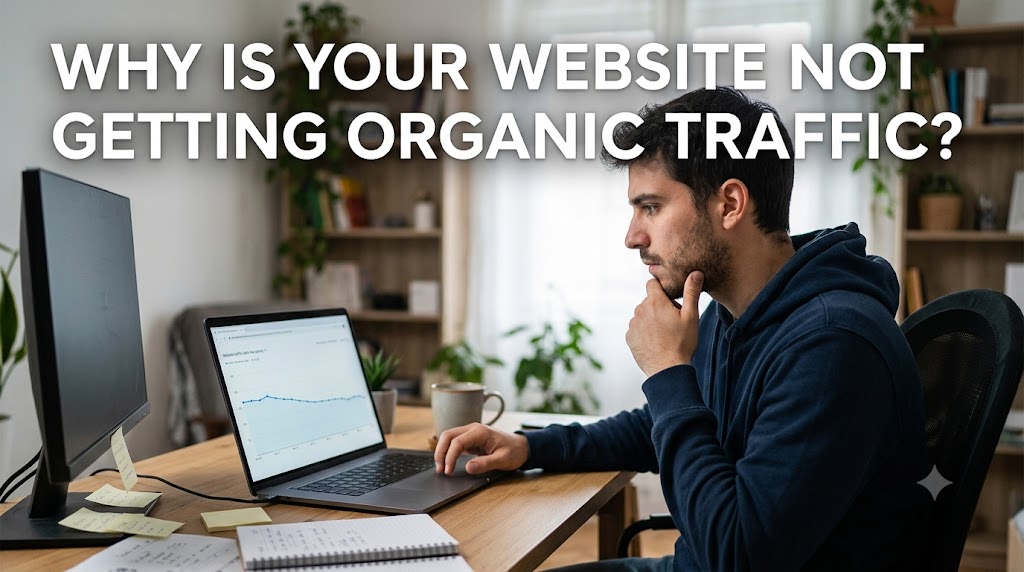
Why Is Your Website Not Getting Organic Traffic? Real Reasons and Practical Fixes
You made a website. You paid a designer, added your services, maybe even wrote a few blog posts. But when you check your analytics, only a handful of people visit, and most of them are friends, family or you.
This is the point where many business owners ask, why is your website not getting organic traffic? If you are asking this question, you are not alone. Thousands of small businesses in Varanasi, Lucknow, Kanpur, Prayagraj and other cities face the same problem every day.
The good news is that low traffic is almost never a mystery. It usually comes from a few clear problems: technical errors, weak content, wrong keywords, no authority, or a poor user experience. Each of these can be found and fixed.
In this guide, the team at Bizzdose explains the problem in simple language. We cover the real reasons, how to check each one, what it costs to fix, and what mistakes to avoid. We also share examples and a step-by-step plan you can follow.
Let’s start with the basics.
What Does “Organic Traffic” Actually Mean?
Organic traffic means visitors who come to your website from unpaid search results. Someone types a question into Google, sees your page in the results, clicks, and lands on your site. You did not pay for that click.
This is different from:
- Paid traffic: visitors from Google Ads or Facebook Ads
- Social traffic: visitors from Instagram, Facebook or YouTube
- Direct traffic: people who type your website address directly
- Referral traffic: visitors who click a link on another website
Organic traffic is valuable because it brings people who are already looking for what you sell. A person searching “digital marketing company in Varanasi” has a need right now. That is a much warmer visitor than someone who saw an ad while scrolling.
Why Organic Traffic Matters for Small Businesses
Here is why smart business owners care about it:
- It keeps working 24 hours a day without paying for every click
- It builds trust, because people trust Google results more than ads
- It usually costs less over time than paid advertising
- It brings visitors who are ready to call, message or buy
- It grows your brand name in your city and beyond
If your site gets no organic traffic, you depend fully on ads, word of mouth or luck. That is risky for any business.
Understanding the Search Intent Behind This Problem
When someone searches why is your website not getting organic traffic, they usually feel confused or frustrated. They want three things:
- A clear list of reasons
- A simple way to check which reason applies to them
- A realistic plan to fix it, without technical confusion
So this article is built around those three needs. We will not throw heavy jargon at you. Where a technical word is needed, we explain it in plain language.
Who Usually Asks This Question?
- Shop owners who recently launched a website
- Doctors, coaches and consultants with a new online presence
- Startup founders who spent money but see no results
- Bloggers whose posts are not showing on Google
- Business owners who have an old website that suddenly lost traffic
Whichever group you belong to, the causes below will help you find your answer.
Why Is Your Website Not Getting Organic Traffic? The Top 12 Reasons
Now let us go through the real reasons one by one. After each reason, we explain how you can check it yourself.
Reason 1: Your Website Is Not Indexed by Google
Indexing means Google has found your page and stored it in its database. If a page is not indexed, it cannot show in search results. Not on page one, not on page ten, nowhere.
This is surprisingly common with new websites. Sometimes it happens because of a wrong setting, such as a “noindex” tag left on by the developer, or a robots.txt file that blocks Google.
How to Check Indexing
- Open Google and type
site:yourwebsite.com - If you see zero results, your site is probably not indexed
- Open Google Search Console and look at the “Pages” report for reasons
Reason 2: You Are Targeting the Wrong Keywords
Many websites write about what the owner wants to say, not what customers actually search. A furniture shop might write “Our passion for craftsmanship,” while customers search “wooden sofa set price in Varanasi.”
Keywords are the bridge between your page and the customer’s question. If the bridge is missing, the traffic never arrives.
Also, some keywords are too competitive. A new website trying to rank for “digital marketing” will struggle against big brands. It is smarter to start with specific phrases like “SEO services for small business in Varanasi.”
Reason 3: Your Content Is Thin or Not Helpful
Google’s Helpful Content System rewards pages that truly help the reader. It lowers pages that are written only to rank.
Thin content looks like this:
- A service page with only 100 to 150 words
- Blog posts copied or rewritten from other websites
- Content that repeats the same sentence in different ways
- Pages with no examples, no steps and no real advice
If your page does not answer the visitor’s question better than the pages already ranking, there is no reason for Google to place you above them.
Reason 4: Weak or Missing On-Page SEO
On-page SEO means the basic setup of each page. When this is done poorly, Google finds it hard to understand what your page is about.
Check these elements:
- Title tag: does it include your main keyword and make people want to click?
- Meta description: does it clearly describe the page?
- Headings: is there one H1 and logical H2 and H3 headings?
- URL: is it short and readable, not something like /page?id=4421?
- Image alt text: do your images have descriptive text?
- Internal links: do your pages link to each other?
Reason 5: Technical SEO Problems
Technical SEO is the engine room of your website. If it is broken, even great content cannot perform. Common technical problems include:
- Broken pages showing 404 errors
- Redirect chains and loops
- Duplicate pages with the same content
- Missing or wrong sitemap
- Pages that load only after JavaScript runs, which Google may miss
- Insecure website (no HTTPS)
Why Technical Errors Hurt More Than You Think
Google has limited time to crawl each website. If your site wastes that time on errors, your important pages may be visited rarely or skipped.
Reason 6: Slow Website Speed
People in tier-2 and tier-3 cities often browse on mobile data, and the connection is not always strong. If your page takes more than three seconds to load, many visitors leave.
Google also measures this through Core Web Vitals, which check loading speed, interactivity and layout stability.
Common reasons for a slow website:
- Very large images that are not compressed
- Cheap hosting that cannot handle traffic
- Too many plugins or heavy themes
- No caching or content delivery network
Reason 7: Your Website Is Not Mobile Friendly
Most searches in India happen on mobile phones. Google uses the mobile version of your site as the main version for ranking. This is called mobile-first indexing.
If your website has tiny text, buttons that are hard to tap, or content that does not fit the screen, both visitors and Google will be unhappy.
Reason 8: No Backlinks or Low Authority
A backlink is a link from another website to yours. Google treats good backlinks like votes of trust. If many trusted websites link to you, Google believes you are reliable.
A brand-new website has zero votes. That does not mean you can never rank, but it means you must earn trust over time through useful content, local listings, news mentions, partnerships and genuine outreach.
A word of caution: buying cheap bulk backlinks can harm you. Google can treat them as spam, and recovery is slow.
Reason 9: Weak EEAT Signals
EEAT stands for Experience, Expertise, Authoritativeness and Trustworthiness. It is how Google judges whether a website deserves trust, especially on topics that affect money, health or safety.
Signs of weak EEAT:
- No “About Us” page or a very vague one
- No address, phone number or real contact details
- No author names or author details on articles
- No reviews, testimonials or case studies
- No privacy policy or terms page
- Content that sounds generic with no real-life experience
Reason 10: Search Intent Mismatch
Search intent is the reason behind a search. If someone searches “how to start a bakery,” they want a guide, not a page selling cake boxes.
Many websites fail because the page type does not match what searchers want:
- Informational intent: people want to learn, so write guides and how-to pages
- Commercial intent: people compare options, so write comparison and review pages
- Transactional intent: people want to buy, so build clear service or product pages
- Local intent: people want something nearby, so optimize for location
Reason 11: Competitors Are Simply Stronger
Sometimes your website has no big error, but competitors have been working on SEO for years. They have more pages, more links and more trust.
In this case, the answer is not to panic. It is to find a smaller, less crowded area where you can win first. Local keywords, niche services and detailed guides are often the easiest starting points.
Reason 12: You Have Not Given SEO Enough Time
SEO is not an overnight tool. A new website often needs three to six months before showing clear movement, and competitive keywords may take longer. This depends on the niche, competition and quality of work.
If you expect results in two weeks, you may stop too early. The reverse is also true: if there is no improvement after many months and no clear plan, something is wrong with the strategy.
How to Find Out the Real Reason: A Simple Self-Audit
Before hiring anyone, you can do a basic check yourself. Here is a 30-minute method that works for most websites.
Step 1: Check Google Search Console
Search Console is a free tool from Google. It shows which pages are indexed, which queries bring impressions, and which errors exist. If you have not connected your website, do that first.
Step 2: Check Google Analytics
Look at your traffic by source. How many visitors come from “Organic Search”? Which pages receive them? Which pages are ignored?
Step 3: Test Your Page Speed
Use free tools like Google PageSpeed Insights. Test both mobile and desktop scores. Note the biggest issues listed.
Step 4: Search Your Own Keywords
Search the exact phrases you want to rank for. Look at the top results. Ask yourself honestly: is my page better than these? Is it as detailed, as clear and as trustworthy?
Step 5: Review Your Content Quality
Read your main pages as a customer. Do they answer questions? Do they give proof? Do they tell the visitor what to do next?
If you do this honestly, you will often find two or three of the twelve reasons above. This is the first step toward solving why is your website not getting organic traffic for your own business.
About Bizzdose: A Digital Marketing Company in Varanasi
Bizzdose is a digital marketing company based in Lalpur, Varanasi. We help local and growing businesses get found online through SEO, content, website improvement and performance marketing.
We understand a thing that big agencies in metro cities sometimes miss: businesses in cities like Varanasi work with different budgets, different customer habits and different levels of digital knowledge. A plan that works for a Mumbai startup may not suit a Varanasi shop, clinic or coaching institute.
So our approach is simple:
- Explain things in plain language
- Fix the real problem, not the most expensive one
- Show clear reports instead of confusing numbers
- Build long-term growth rather than quick tricks
Our Location and Contact Details
Bizzdose
Sector-B, JP Complex, Lalpur, Varanasi, Uttar Pradesh 221002
Phone: +91 84236 81741
Website: https://bizzdose.com/
You can visit us, call us or message us to discuss your website. We are happy to talk in Hindi, English or Hinglish, whichever you are comfortable with.
Why Choose Bizzdose for SEO and Digital Marketing?
Choosing an SEO partner is a big decision. Many business owners have been burned by agencies that promised “first page in 15 days” and then disappeared. Here is how we try to be different.
Honest Promises, No Fake Guarantees
Nobody can guarantee a number one rank on Google, because Google’s system is controlled only by Google. Anyone who promises it is not being honest. What we promise is a proper process, regular work and open reporting.
Local Understanding
We know the Varanasi market. We understand how customers here search, what questions they ask and how local trust works. This helps us choose keywords and content that match real customer behavior.
Clear Communication
You will not be left guessing. We share what we are doing, why we are doing it and what it means for your business.
Focus on Business Results, Not Just Ranking
A page one rank is nice. But phone calls, enquiries, form fills and sales are what pay your bills. We track those as well.
Our Unique Selling Points
- Plain-language reporting: every report explains what changed and what to do next
- Audit before action: we find the exact problem first instead of selling a ready-made package
- Local plus national approach: we can help you win in Varanasi and also grow beyond your city
- EEAT-focused content: we build content around real experience and trust signals
- Flexible plans: options for small budgets as well as larger projects
- Direct access: you speak with the people who actually work on your project
Our Detailed Services
If you are wondering why is your website not getting organic traffic and what can fix it, these are the services that usually help.
SEO Audit and Strategy
We check your website completely: technical health, content, keywords, links and competitors. You receive a clear list of what is wrong, what is most urgent and what can wait.
Keyword Research and Search Intent Mapping
We find the phrases your real customers use. Then we match each phrase to the right page and the right intent, so every page has a clear purpose.
On-Page SEO
We improve titles, headings, meta descriptions, internal links, image text and content structure so Google and visitors understand each page quickly.
Technical SEO
We fix indexing problems, crawl errors, site speed, mobile usability, sitemap setup, schema markup and other behind-the-scenes issues.
Content Writing and Content Strategy
We create helpful articles, service pages, landing pages and FAQs written in a simple human tone. The aim is to answer customer questions better than the pages that are ranking today.
Local SEO and Google Business Profile
We help you appear in “near me” and local searches. This includes Google Business Profile setup, local citations, reviews strategy and location-based pages.
Link Building and Digital PR
We build links in a safe way through quality content, relevant listings, partnerships and outreach. We do not use spammy shortcuts.
Website Design and Speed Improvement
If your design or hosting is the real blocker, we help improve structure, mobile layout, speed and user experience.
Social Media and Paid Marketing Support
While SEO builds slowly, ads and social media can bring early enquiries. We can run these alongside SEO so your business does not wait with zero leads.
Reporting and Analytics
We set up tracking for calls, forms and key actions, so you can see which channel brings real business.
Industries We Serve
SEO principles are similar across industries, but the content and keywords are different. We have the process to work with businesses such as:
- Healthcare clinics, doctors and dental practices
- Coaching centers and educational institutes
- Real estate and property dealers
- Restaurants, hotels and tourism businesses
- Retail shops and local e-commerce stores
- Jewellery, fashion and handloom businesses
- Interior designers and builders
- Legal, accounting and consulting services
- Startups and small manufacturers
- Wedding, events and photography businesses
Varanasi is a city of tourism, education, textiles and healthcare. Each of these has its own search behavior, and we shape the strategy accordingly.
Benefits for Customers
When a website starts getting steady organic traffic, the benefits go beyond visitor numbers.
- More qualified enquiries: visitors are people who are already searching for your service
- Lower cost per lead over time: you are not paying for every click
- Better brand trust: appearing on Google builds credibility
- Competitive edge: you show up before competitors who ignore SEO
- Long-term asset: good content and rankings continue to work for months and years
- Better user experience: SEO fixes often make the site better for real visitors too
- Data to make decisions: you learn what customers search and what they want
Our Step-by-Step Working Process
Many people ask us how the work actually happens. Here is the process we follow.
Step 1: Discovery Call
We learn about your business, customers, goals, budget and past experience. We listen first, because every business has a different situation.
Step 2: Complete Website Audit
We review technical health, content, keywords, backlinks, speed and user experience. We also study your top three to five competitors.
Step 3: Strategy and Priority Plan
We create a plan that lists what to fix first. Quick wins come before long projects. You will know what is happening each month.
Step 4: Technical and On-Page Fixes
We solve indexing problems, improve page structure, fix speed issues and update titles, headings and internal links.
Step 5: Content Creation and Optimization
We write new pages and improve old ones. Each piece is built to match search intent and show real expertise.
Step 6: Authority Building
We start building trust through local listings, quality links, reviews and brand mentions.
Step 7: Tracking and Monthly Reporting
We track rankings, traffic, enquiries and conversions. Every month, we explain the results in simple words.
Step 8: Continuous Improvement
SEO is never finished. We keep updating content, watching competitors and improving based on data.
Tools and Technologies We Use
Good tools make the work faster and more accurate. Depending on the project, we use:
- Google Search Console: to check indexing, queries, clicks and errors
- Google Analytics 4: to understand visitor behavior and conversions
- Google PageSpeed Insights: to measure speed and Core Web Vitals
- Google Business Profile: for local visibility
- Rank Math or Yoast SEO: for on-page setup in WordPress
- Screaming Frog or similar crawlers: to find technical errors
- Ahrefs, SEMrush or similar tools: for keyword and competitor research
- Google Trends and AnswerThePublic type tools: to understand what people ask
- Schema generators and testing tools: for structured data
Tools only give data. The real value comes from the person who reads that data correctly and knows what action to take.
Pricing Factors: What Decides the Cost of SEO?
We avoid quoting fixed prices in a blog because every website is different. But it is important for you to understand what affects the cost.
Factors That Affect SEO Pricing
- Current condition of your website: a site with many errors needs more work
- Size of the website: 10 pages and 500 pages need different effort
- Competition level: ranking for a local keyword costs less than a national one
- Number of services or locations: more targets mean more content and optimization
- Content needed: new articles, service pages and landing pages add to the work
- Link building needs: competitive niches need stronger authority work
- Reporting and support level: how often you want calls and updates
- Combined services: SEO with ads, social media or web design changes the plan
A Practical Tip on Budget
If someone offers a “full SEO package” for an extremely low price, ask what exactly is included. Quality writing, technical work and honest link building need time and skill. Very cheap packages often use shortcuts that may hurt your website later.
At Bizzdose, we first do an audit and then suggest a plan that matches your budget and goals. You can call +91 84236 81741 to discuss your needs.
Common Mistakes People Make With Organic Traffic
Many website owners make the same errors again and again. If you are still searching for why is your website not getting organic traffic, check whether you are doing any of these.
Mistake 1: Expecting Instant Results
SEO takes time. Changing your title every week or switching agencies every month resets progress.
Mistake 2: Stuffing Keywords Everywhere
Repeating the same keyword again and again makes your page sound robotic. Google can detect it, and visitors dislike it. Write for humans first.
Mistake 3: Copying Content From Others
Copied or lightly rewritten content gives Google no reason to rank you. Original thinking and real experience are what stand out.
Mistake 4: Ignoring Mobile Users
Many owners check their website only on a laptop. Always test on a phone, preferably a mid-range one with average internet.
Mistake 5: Not Using Search Console
This free tool tells you what Google sees. Ignoring it is like running a shop without ever looking at the stock register.
Mistake 6: Buying Cheap Backlinks
Hundreds of low-quality links from unknown sites can lead to penalties or ignored links. A few good links beat a thousand bad ones.
Mistake 7: Publishing Without a Plan
Posting random blog topics will not help. Every page should target a specific keyword, a specific intent and a specific customer need.
Mistake 8: Forgetting Local SEO
If you serve customers in a city, your Google Business Profile, local listings and reviews matter a lot. Many local businesses skip this and lose easy traffic.
Mistake 9: No Clear Call to Action
Even if people visit, they will not become customers if the page does not tell them what to do. Add clear buttons, phone numbers and contact forms.
Mistake 10: Never Updating Old Content
Old pages with outdated information lose rank over time. Refreshing content with new facts and examples keeps it useful.
Why Bizzdose Is Better Than Many Competitors
Every agency says it is the best. Instead of making big claims, here is a simple comparison of how we aim to work compared with a typical low-quality service provider.
Bizzdose vs Typical Low-Cost SEO Providers
| Area | Typical Low-Cost Provider | Bizzdose Approach |
|---|---|---|
| Promises | “Rank 1 in 15 days” | Honest timelines, no false guarantees |
| Audit | Ready-made template | Customized audit for your website |
| Content | Copied or low-quality | Original, helpful, human-style writing |
| Links | Bulk spammy links | Quality, relevant, safe link building |
| Reporting | Confusing numbers | Simple monthly report with next steps |
| Communication | Hard to reach | Direct contact with the working team |
| Local focus | Generic strategy | Varanasi and Uttar Pradesh market understanding |
| Goal | Show activity | Increase enquiries and business growth |
What Makes Us Stand Out
- We focus on the problem behind the question why is your website not getting organic traffic, not on selling a package
- We follow Google’s helpful content and EEAT ideas honestly
- We keep our language simple, so you always understand what we are doing
- We treat your business like a long-term partner, not a one-time project
Real-World Examples of Traffic Problems and Fixes
The examples below are illustrative scenarios based on common patterns we see in small business websites. They are meant to show how problems and fixes work, not to claim specific results.
Example 1: The Local Clinic With No Visitors
A clinic had a nicely designed website, but the homepage said only “Welcome to our clinic.” There was no mention of services, doctors or location. People searching “skin doctor in Varanasi” had no reason to see this website.
Fix: Separate service pages were created for each treatment, with doctor profiles, location details, patient FAQs and a Google Business Profile. The site began to match real searches.
Example 2: The Shop That Blocked Google by Mistake
An online store was built by a developer who left a “discourage search engines” setting on during development. It stayed on after launch for months.
Fix: After the setting was removed and the sitemap was submitted, pages slowly began to get indexed. The owner had been spending on ads for months without knowing this.
Example 3: The Blog With 80 Posts and No Traffic
A business blog had many posts, but most were short and unrelated to what customers needed. Several posts competed for the same keyword.
Fix: Weak posts were merged, strong ones were expanded, and a clear topic structure was created. Fewer, better pages replaced many weak ones.
Example 4: The Slow Handloom Store
A store with large product photos took many seconds to load on mobile. Customers left before seeing the products.
Fix: Images were compressed, hosting was improved and unnecessary plugins were removed. Visitors stayed longer, and the site became easier for Google to crawl.
Case Studies: How a Structured SEO Plan Works
These are generic, sample case studies that show the kind of process and improvement a structured plan can aim for. Actual results always depend on the business, competition and time.
Case Study 1: Service Business in a Local Market
Starting problem: A home services company had a website but received almost no search visits and few calls from Google.
What was found: Indexing was fine, but pages targeted broad keywords like “home services” and had no city-specific content. The Google Business Profile was incomplete.
What was done:
- Created pages for each service with local keywords
- Completed and optimized the Google Business Profile
- Added customer questions as FAQs on each page
- Improved page speed and mobile layout
- Collected genuine customer reviews
Expected direction: Gradual growth in local impressions, then clicks, then enquiries over several months.
Case Study 2: Educational Institute
Starting problem: An institute depended fully on pamphlets and word of mouth. Its website was almost invisible online.
What was found: The website had one long page with all courses, no separate course pages and no student success content.
What was done:
- Built dedicated pages for each course
- Added syllabus, fees information style content and FAQs
- Created helpful guides on exam preparation
- Added teacher profiles to improve EEAT
Expected direction: More course-related searches finding the website and more admission enquiries from organic sources.
Case Study 3: Small E-Commerce Store
Starting problem: Product pages were copied from manufacturer descriptions, so hundreds of other stores had the same text.
What was done:
- Rewrote main product pages with original descriptions
- Added size guides, usage tips and customer questions
- Fixed duplicate category pages
- Added product schema
Expected direction: Better indexing of key pages and stronger product visibility over time.
Customer-Focused Solutions: How We Think About Your Business
Good SEO begins with understanding your customer, not search engines. Before we write a single line, we try to answer questions like:
- Who is your ideal customer?
- What problem are they trying to solve?
- What do they type into Google?
- What doubts stop them from contacting you?
- What proof will make them trust you?
When your website answers these honestly, rankings and enquiries both tend to follow.
How We Adjust Solutions for Different Business Sizes
- Very small businesses: we focus first on local SEO, Google Business Profile and a few strong pages
- Growing businesses: we add content, service pages and link building
- Established businesses: we do deeper technical work, content expansion and competitor analysis
A Practical 90-Day Plan to Improve Organic Traffic
If you want to start right now, here is a simple plan you can follow, even before hiring any agency.
Days 1 to 30: Foundation
- Connect Google Search Console and Google Analytics
- Check indexing and fix any blocking settings
- Test mobile experience and page speed
- Fix broken links and missing titles
- Complete your Google Business Profile
- Add clear contact details and an About page
Days 31 to 60: Content and Relevance
- Pick 10 to 15 keywords based on what customers really search
- Match each keyword to one page
- Improve service pages with more detail, FAQs and proof
- Add images with proper alt text
- Link related pages together
Days 61 to 90: Authority and Growth
- Ask happy customers for genuine reviews
- Get listed in trusted local directories
- Publish helpful guides that answer customer questions
- Look for partnerships and mentions from local websites
- Review your Search Console data and improve weak pages
This plan will not make you number one overnight, but it creates the strong base that SEO needs.
How Google’s Helpful Content System and EEAT Affect Your Traffic
If you want a lasting answer to why is your website not getting organic traffic, you must understand how Google judges quality today.
What Is the Helpful Content System?
It is a ranking system that tries to reward content written for people and reduce content written mainly for search engines. Pages that feel complete, honest and useful perform better.
How to Show Experience and Expertise
- Write from real work, not just theory
- Share examples, photos, numbers or lessons you learned
- Add the author name and a short author bio
- Explain things clearly instead of using heavy language
How to Show Authority and Trust
- Show your business address and phone number clearly
- Add real reviews and testimonials
- Mention where your information comes from
- Keep your website secure with HTTPS
- Publish privacy, terms and refund pages where needed
- Keep content updated
Local SEO Tips for Businesses in Varanasi
If your customers are in or near Varanasi, local SEO can be your fastest path to results.
- Create and verify your Google Business Profile with correct address and timings
- Use area names naturally, such as Lalpur, Sigra, Lanka, Godowlia, Cantt and Sarnath, where they are relevant to your service
- Add the same business name, address and phone number everywhere online
- Ask customers for honest Google reviews and reply to them
- Upload real photos of your shop, team and work
- Create location-based service pages, such as “digital marketing services in Varanasi”
- Add a Google Map to your contact page
- Mention local events, festivals or tourism seasons in content where it fits
Many competitors in smaller cities ignore these steps. That is your opportunity.
Frequently Asked Questions (FAQs)
1. Why is my website not getting organic traffic even after publishing many pages?
Publishing many pages does not guarantee traffic. The pages must be indexed, target the right keywords, match search intent and have enough quality and trust. If pages are thin, duplicate or too similar to each other, Google may ignore them. Check Search Console first to see whether your pages are even indexed.
2. How long does it take to get organic traffic to a new website?
Most new websites need about three to six months to show steady progress. Competitive keywords can take longer. The timeline depends on competition, content quality, technical health and how consistently work is done.
3. How can I check if Google has indexed my website?
Type in Google to see indexed pages. For more detail, use the Pages report in Google Search Console, which shows indexed pages and the reasons why others are not indexed.
4. Can a slow website reduce organic traffic?
Yes. A slow website frustrates visitors and may also hurt your performance in Google’s page experience signals. Compress images, use good hosting, reduce heavy plugins and test on mobile regularly.
5. Does Google Business Profile help in getting local organic traffic?
Yes, for local searches it is very important. A complete and active profile with correct details, photos and reviews can help your business appear in local results and on Google Maps.
6. Are backlinks still important for ranking?
Yes, quality backlinks remain an important trust signal. But relevance and quality matter more than quantity. A few links from reputable, relevant websites are better than many spammy ones.
7. Is it better to hire an SEO company or do SEO myself?
You can handle the basics yourself if you have time and are willing to learn. But if your market is competitive or you need faster, structured progress, an experienced SEO team can save time and avoid costly mistakes. Choose a partner who is open about their process and does not give false guarantees.
8. What is the difference between organic traffic and paid traffic?
Organic traffic comes from unpaid search results. Paid traffic comes from ads where you pay per click or impression. Organic takes longer to build but can continue to bring visitors without paying for each click.
9. Why did my organic traffic suddenly drop?
Common causes include a Google algorithm update, technical errors after a website change, lost backlinks, new competitors, expired content or accidental noindex settings. Compare dates in Search Console and Analytics to find when the fall began, then investigate what changed around that time.
10. How much does SEO cost in Varanasi?
The cost depends on your website’s condition, competition, number of pages, content needs and the services included. Instead of choosing only on price, ask for an audit and a clear plan. You can contact Bizzdose at +91 84236 81741 for a customized suggestion.
Conclusion: Your Website Can Get Organic Traffic With the Right Plan
If you have been asking why is your website not getting organic traffic, remember this: the cause is rarely one big secret. It is usually a mix of small issues, such as indexing problems, wrong keywords, weak content, slow speed, low trust or lack of patience.
The good news is that every one of these problems can be found and improved. Start with the self-audit in this guide. Fix the basics. Create content that truly helps your customers. Build trust step by step. And give the work the time it needs.
If you would rather have an experienced team look at your website and give you an honest answer, Bizzdose is ready to help.
Call to Action: Talk to Bizzdose Today
Stop guessing. Let us find the real reason your website is not getting visitors and build a plan to fix it.
Bizzdose: Digital Marketing Company in Varanasi
Sector-B, JP Complex, Lalpur, Varanasi, Uttar Pradesh 221002
Phone / WhatsApp: +91 84236 81741
Website: https://bizzdose.com/
Call us today or visit our website to ask for your website audit discussion. We will explain everything in simple words, with no pressure and no false promises.