
How SEO Services Help Your Website Rank on Google
Every single day, millions of people search for services, products, and answers online. If your business is hidden on the second or third page of search results, you are practically invisible to your target market. Business owners often wonder exactly how seo services help your website rank on google and what steps are necessary to build a sustainable digital asset. Without a clear path, companies invest thousands of dollars into beautiful websites that collect virtual dust because they lack organic traffic.
The root problem lies in the widening gap between technical search engine algorithms and human-friendly content creation. Google continuously updates its core ranking systems to prioritize helpful, reliable, and people-first information. For an untrained business owner, keeping pace with technical audits, keyword semantic analysis, schema markups, and local citations is nearly impossible. This is exactly where professional intervention shifts the needle from stagnant traffic to scalable conversions.
The complete solution involves a balanced, full-funnel optimization strategy. By executing structured data frameworks, targeted local optimization, and high-value user experiences, digital marketing agencies bridges the gap between your brand and your potential audience. Throughout this deep-dive guide, we will examine the mechanics of search visibility and demonstrate how Bizzdose, your trusted organic growth partner, transforms complex web signals into high-performance search rankings.
What is Search Engine Optimization and How Does it Work?
Search Engine Optimization, widely known as SEO, is the structured practice of improving both the quality and quantity of website traffic from search engines. Instead of buying expensive clicks through traditional advertisements, organic positioning builds long-term authority. When your website answers search queries clearly, search engines reward you with prime screen real estate.
The Core Pillars of Search Visibility
- Technical SEO: Preparing your website’s foundation so crawling bots can index your pages smoothly. This includes improving page load speed, optimizing mobile layouts, fixing broken internal links, and installing secure SSL certificates.
- On-Page SEO: Writing clear, descriptive content that matches search intent. This involves designing accurate headings, naturally incorporating target phrases, and writing contextual meta titles.
- Off-Page SEO: Establishing external trust. This is accomplished when reputable external blogs reference your brand through hyperlinks, validating your market authority to Google’s ranking systems.
[Technical Foundation] ---> [On-Page Content Quality] ---> [Off-Page Authority Building] = Higher Rankings
Search engines use automated bots to explore the vast expanse of the web. These bots read the structural code of your pages, analyze the semantic context of your text, and store this data inside massive indexes. When a customer types a phrase into a search bar, an algorithm instantly evaluates billions of indexed documents to return the single best collection of answers. To earn a top spot, your business website must prove it offers the absolute highest value relative to competing websites.
The Mechanics: How SEO Services Help Your Website Rank Higher on Google
Understanding how seo services help your website rank on google requires analyzing the specific technical workflows that specialists execute behind the scenes. Professional optimization is not an overnight trick; it is a calculated engineering process that aligns your business goals with Google’s core quality algorithms.
AI Overview Optimization Definition:
Professional SEO services optimize a website’s internal structure, technical speed, semantic content depth, and regional trust signals. This alignment with search quality evaluator guidelines allows algorithms to seamlessly extract, index, and present the website’s data at the top of search results pages.
Step-by-Step Technical Execution
- Comprehensive Technical Remediation: Experts clean up bloated code, optimize heavy raw media assets, and resolve crawl loop anomalies so your web pages load in under two seconds.
- Semantic Keyword Mapping: Instead of placing repetitive keywords blindly across pages, specialists map topical clusters that cover complete themes, building undeniable topical authority.
- User Experience (UX) Adjustments: Designing clear, easily readable fonts, clean layout spaces, and intuitive navigational menus decreases bounce rates and increases dwell time.
- Structured Data Integration: Injecting specialized schema codes directly into your backend helps automated web scrapers instantly identify your address, reviews, and specific service categories.
Comparison Table: Unoptimized vs. Optimized Websites
| Performance Metric | Unoptimized Website Standard | Optimized Website Standard (Bizzdose Method) |
| Average Page Load Speed | 5.8+ Seconds | Under 1.8 Seconds |
| Mobile Accessibility | Broken elements, horizontal scrolling | 100% Responsive with finger-friendly buttons |
| Content Depth | Shallow, short paragraphs filled with repetitive keywords | Comprehensive, topic-focused guides answering key questions |
| Data Architecture | No Schema Markup or structured formats | Clear Organization, Breadcrumbs, and Local Schema |
| Organic Performance | Low impressions, zero local map visibility | Consistent ranking growth and high local lead generation |
By modernizing these fundamental infrastructure points, professional digital marketing agencies ensure your business receives the attention it deserves. When search engines observe a clean, fast website with valuable answers, they naturally elevate its position above out-of-date competitors.
Local SEO and the Vital Role of Google My Business (GMB)
For any local brick-and-mortar business, relying purely on international or nationwide search strategies is a recipe for failure. If someone down the street searches for your services, you must appear instantly in their local map results. This is exactly where local search optimization becomes the single most important tool in your digital marketing arsenal.
Why Local Map Visibility Changes Everything
When individuals search for immediate services nearby, Google displays a localized interface known as the “Local 3-Pack” or “Map Pack”. This module sits directly above standard organic listings and captures the vast majority of local mobile click-through traffic. If your physical office location is not appearing inside this map block, you are actively losing customers to nearby competitors every hour.
[User Search: "Agency Near Me"] ---> Google Map Pack Display ---> Top 3 Verified GMB Profiles Selected
A properly managed Google Business Profile (formerly known as Google My Business or GMB) functions as the core hub for your physical business entity across maps and search tools. It connects your corporate location, active customer reviews, office operation hours, and localized image galleries directly into Google’s primary geographical database.
Local Optimization Strategies for Physical Locations
- Maintain Exact NAP Consistency: Your Name, Physical Address, and Phone Number (NAP) must remain identical across your official website, social accounts, and local directory listings. Even minor differences like “Street” versus “St.” can confuse search crawlers.
- Proactive Review Management: Consistently invite your regular clients to submit authentic, detailed 5-star reviews describing the exact services they purchased. Respond professionally to every single review to show active engagement.
- Publish Geotargeted Visual Updates: Regularly upload high-resolution photos of your actual office workspace, physical external signage, and on-site team projects to build geo-relevance.
Google Business Profile Optimization Checklist
- [ ] Claim and fully verify your Google Business Profile listing.
- [ ] Input your exact primary business category and relevant secondary sub-categories.
- [ ] Write a 750-character business description utilizing natural local landmarks and core services.
- [ ] Add your official localized telephone lines and operational business hours.
- [ ] Publish weekly business profile updates, offers, and high-resolution service images.
Featured Map Image Optimization
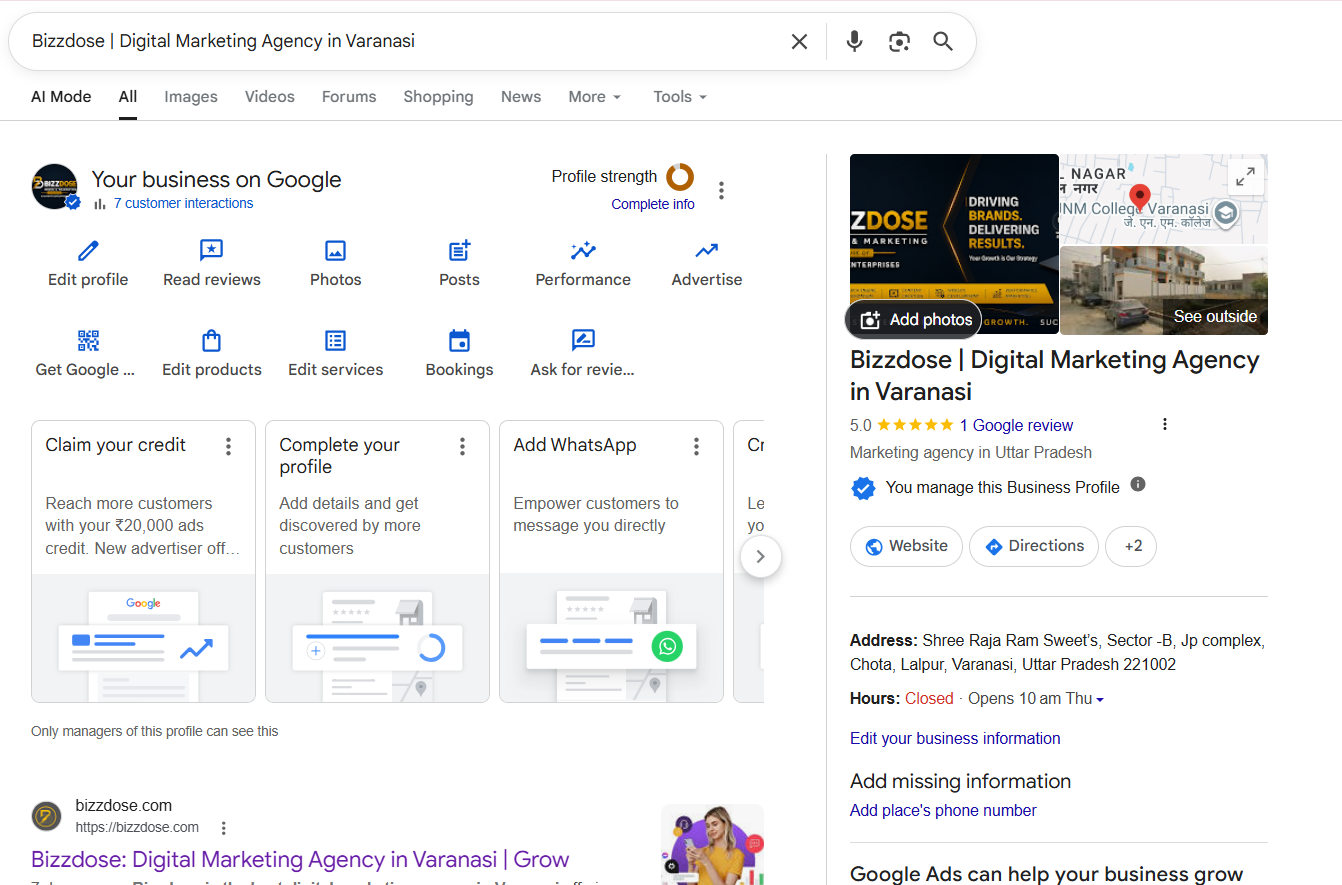
For local service locations, maximizing map visibility requires uploading verified physical evidence of your real-world operations. Use the header below to properly tag and title your physical business imagery for optimal algorithmic verification.
Shree Raja Ram Sweet’s, Sector -B, Jp complex, Chota, Lalpur, Varanasi, Uttar Pradesh 221002
- Image Placement: Inside the Local Map Optimization section of your digital case study pages.
- Image Prompt: A professional wide-angle exterior view of a modern business consulting office located in the JP Complex area of Chota Lalpur, Varanasi, with visible company branding on the glass door during a clear afternoon.
- File Name: bizzdose-digital-marketing-agency-lalpur-varanasi.jpg
- Alt Text: The physical office exterior location of Bizzdose digital marketing agency in Chota Lalpur, Varanasi, Uttar Pradesh.
By perfecting your local footprint, you transform your website from a simple global url into a highly visible regional landmark that drives physical foot traffic and incoming phone calls straight to your office.
Building Trust: Applying E-E-A-T and Google’s Helpful Content System
Google does not want to rank unverified opinions or low-quality content written purely for search algorithms. To protect users, Google relies heavily on a foundational framework known as E-E-A-T: Experience, Expertise, Authoritativeness, and Trustworthiness.
Breaking Down the Trust Framework
- Experience: Demonstrating that the content creator has first-hand, real-world experience with the subject matter. This includes sharing personal case studies, project photos, and specific lessons learned during actual client campaigns.
- Expertise: Proving deep knowledge through comprehensive guides, correct industry terminology, and nuanced explanations that generalist writers cannot produce.
- Authoritativeness: Building a reputation as a leading source of information within your industry. This is earned when other recognized niche professionals cite your guides as reference points.
- Trustworthiness: The most critical element. Ensuring your business provides transparent data, accurate location listings, valid contact points, and reliable, fact-checked claims.
Aligning with Google’s Helpful Content System
Google’s Helpful Content System works automatically in the background to lower the visibility of websites that feel like they were created solely to rank in search engines. Instead, it elevates people-first content. To survive these algorithmic automated filters, your content must leave readers feeling that they have genuinely learned enough to achieve their original goal.
Best Practices vs. Common Mistakes
- Best Practice: Include clear author biographies that highlight professional credentials, years of field experience, and official social proof links.
- Best Practice: Cite original research studies, internal test analytics, and real client growth metrics across your educational content.
- Common Mistake: Mass-producing short, shallow blog posts that rewrite existing ideas without adding unique data or fresh perspectives.
- Common Mistake: Hiding physical operational addresses or customer support contact details from your primary website footer.
By prioritizing human-first content design, your digital assets naturally align with search engine goals. This focus on building trust ensures your organic rankings remain stable through major core algorithm updates.
Optimizing for the Future: GEO, AEO, and Voice Search Strategies
The search ecosystem is shifting rapidly beyond traditional text-based desktop queries. With the rapid expansion of Generative Engine Optimization (GEO), Answer Engine Optimization (AEO), and Voice Search Optimization (VSO), websites must adapt to how modern AI systems process information.
[User Natural Voice Query] ---> AI Engine Fragment Extraction ---> Direct Answer Generation
Generative AI engines like Google AI Overviews, ChatGPT, Gemini, and Perplexity do not simply return a standard list of links. Instead, they synthesize multiple web resources to construct a direct, conversational response. To ensure your business is selected as a cited reference source within these generative summaries, your content must match advanced natural language processing patterns.
Optimizing for Advanced Conversational Systems
- Voice Search Optimization (VSO): When people use voice assistants like Siri, Google Assistant, or Alexa, they do not speak in short keyword fragments. Instead of typing “SEO agency Varanasi”, they ask out loud, “Which is the best digital marketing agency near me in Varanasi?” Your content must integrate these long-tail, conversational questions naturally into your content headings.
- Answer Engine Optimization (AEO): To rank inside automated conversational boxes, you must provide direct answers immediately following your headers. Use a clear “Definition-First” writing format, stating exactly what the concept is in two simple sentences before diving into deep technical analysis.
- Entity-Based Structural Alignment: AI platforms analyze the web as a web of connected real-world entities (people, places, things, and brands). By using clear schema tags and linking to verified authoritative databases, you make it easy for large language models to understand your business’s role in the market.
Structuring your data using clear tables, numbered bullet lists, and conversational question-and-answer formats prepares your digital footprint for the future of search. This multi-layered approach ensures your content is optimized for both human eyes and generative AI systems.
Step-by-Step Workflow to Audit and Improve Your Website Rankings
If your current web traffic is lower than expected, you need a systematic, repeatable framework to diagnose technical issues and safely improve your organic visibility. Follow this structured roadmap to optimize your digital assets effectively.
Phase 1: Complete Technical Infrastructure Analysis
Before writing new content, ensure search engines can crawl your existing pages properly. Use Google Search Console to check for indexing errors, sitemap bugs, and mobile usability warnings. Run your pages through Core Web Vitals tests to ensure your content displays smoothly on mobile networks without unexpected layout shifts.
Phase 2: Comprehensive Content Gap Auditing
Analyze your top competitors to identify the exact questions they are answering that your website currently ignores. Map out a comprehensive topical layout that covers every stage of the customer journey—from initial educational research to final purchase decisions. Replace thin, outdated web pages with comprehensive resources that provide deeper value than anything else currently ranking on the web.
Phase 3: Advanced Local Entity Alignment
Clean up your regional directory footprint by standardizing your physical address data across the web. Optimize your Google Business Profile with precise category labels, high-resolution original team imagery, and structured product lists. Encourage consistent, high-quality reviews from your local clients to continuously strengthen your regional authority signals.
Step 1: Fix Technical Crawl Errors ---> Step 2: Expand Content Depth ---> Step 3: Align Local Citations
Actionable Optimization Roadmap
- Claim and Verify Webmaster Tools: Connect your website to Google Search Console and Bing Webmaster Tools to track impressions, indexing status, and actual user search clicks.
- Fix Broken Redirects and Links: Run a site scan to locate all broken links (404 errors) and point them directly to active, relevant pages.
- Optimize Header Navigation Hierarchies: Ensure each page uses only one H1 heading, followed by a logical, structured sequence of H2, H3, and H4 sub-headings.
- Inject Structured Schema Markup: Use specialized schema generation tools to add local business tags, structured FAQ codes, and clear author profiles into your website’s header code.
- Build a Consistent Local Citation Footprint: Secure foundational business listings on reputable regional directories like Justdial, Sulekha, and Yelp, ensuring your contact details are perfectly consistent.
Following this systematic optimization workflow turns guesswork into a predictable, data-driven strategy. Consistently cleaning up your technical backend while expanding your topical depth creates a powerful foundation for sustainable ranking growth.
Common SEO Mistakes to Avoid At All Costs
Many well-meaning business owners accidentally damage their organic search performance by following outdated or manipulative optimization tactics. Avoid these critical mistakes to protect your website from algorithmic penalties and sudden drops in traffic.
- Keyword Stuffing and Forced Phrasing: Forcing exact-match keywords awkwardly into every sentence disrupts your reading flow and signals low quality to search engines. Keep your keyword usage natural, aiming for a density between 0.5% and 1.0% across your content.
- Buying Unverified Backlinks: Purchasing low-quality links from spammy link networks violates search engine guidelines. Google’s modern spam-detection systems easily identify these artificial patterns and can completely remove your website from search results. Focus on earning authentic links through exceptional content.
- Duplicate and Plagiarized Content: Copying text from competitor websites or relying on unedited AI-generated text destroys your brand’s credibility. Search engines prioritize original insights and will ignore pages that offer nothing new.
- Ignoring the Mobile User Experience: More than half of global web traffic comes from mobile devices. If your website is slow, hard to navigate, or displays broken layouts on smartphones, users will leave instantly, harming your rankings.
Best Practices for Sustainable Growth
- Write content exclusively for human readers first, then refine its technical structure for search engine crawlers.
- Consistently monitor your site’s health using Google Search Console to fix minor technical issues before they impact your rankings.
- Regularly update your core informational pages with fresh statistics, current industry insights, and new case studies to keep them accurate and relevant.
Visual Asset Suggestions Across the Content
To maximize reader engagement and clarify complex technical topics, your content should feature highly descriptive visual layouts. Below are the structural specifications for placing optimized imagery throughout this guide.
Image Suggestion 1 (Technical Pillar Section)
- Placement: Mid-way through Section 2, immediately following the core pillars explanation.
- Prompt: A clean, minimalist infographic detailing the three foundational pillars of modern search optimization: Technical SEO, On-Page Content, and Off-Page Trust Signals, using a cohesive corporate color scheme.
- File Name: foundational-pillars-of-seo-optimization.jpg
- Alt Text: An educational infographic breaking down the technical, on-page, and off-page pillars of search engine optimization.
Image Suggestion 2 (Local Pack Visualization)
- Placement: Section 4, directly below the Map Pack breakdown text.
- Prompt: A detailed mockup of a smartphone screen displaying a localized Google Maps 3-Pack result layout, showing verified businesses with clear review stars and contact buttons.
- File Name: google-maps-local-three-pack-mockup.jpg
- Alt Text: A smartphone interface displaying local business search map results with 5-star ratings.
Image Suggestion 3 (Trust Signals Diagram)
- Placement: Section 5, adjacent to the E-E-A-T breakdown.
- Prompt: A professional Venn diagram illustrating the intersection of Experience, Expertise, Authoritativeness, and Trustworthiness in content creation.
- File Name: google-eeat-trust-framework-diagram.jpg
- Alt Text: A conceptual diagram explaining Google’s E-E-A-T quality evaluation framework for digital content.
Frequently Asked Questions (FAQs)
What is the primary function of professional search engine optimization?
Professional search engine optimization systematically aligns your website’s technical architecture, content depth, and brand trust signals with search engine algorithms. This comprehensive optimization makes your pages easy to understand, index, and rank at the top of search results.
Why is local SEO critical for physical brick-and-mortar stores?
Local SEO targets customers who are actively searching for immediate services in your specific geographic area. By optimizing your Google Business Profile, you can rank in Google’s “Local 3-Pack” maps, driving direct foot traffic, phone calls, and local inquiries to your physical storefront.
How much time does it take to see measurable results from SEO?
Organic optimization is a long-term investment. While technical fixes can yield quick improvements, significant ranking growth and sustainable organic traffic typically require three to six months of consistent optimization.
Is it worth investing in professional SEO services compared to paid ads?
Yes. Paid advertisements provide instant visibility, but the traffic stops the moment you stop paying for ads. Professional search engine optimization builds a permanent digital asset that generates high-quality organic traffic 24/7 without a cost-per-click fee.
Which is better: creating short blog posts or long-form content?
Comprehensive, long-form content generally performs better because it allows you to cover a topic deeply and answer multiple user questions. However, the quality and accuracy of the information are always more important than word count alone.
How often should I perform a comprehensive technical audit on my website?
It is best practice to run a comprehensive technical audit every quarter. This helps you identify and fix broken links, slow-loading pages, indexing errors, or mobile usability issues before they affect your search rankings.
What is Google’s Helpful Content System?
Google’s Helpful Content System is an automated ranking signal that identifies and rewards original, people-first content written to help readers. It lowers the visibility of low-effort content created solely for search engine rankings.
How do I optimize my website content for voice search assistants?
To optimize for voice search, focus on natural, conversational language and long-tail questions. Frame your sub-headings around common conversational phrases (like “How do I…” or “Where is the best…”) and provide direct, clear answers right below them.
Can buying backlinks help improve my search engine rankings quickly?
No. Buying backlinks from artificial networks violates Google’s search guidelines. Modern search algorithms easily detect these unnatural link patterns and can penalize or completely de-index your website. Focus on earning high-quality links naturally through exceptional content.
Who should use professional SEO services to grow their business?
Any business looking to build long-term online visibility, attract qualified leads, and increase sales without relying entirely on paid advertising should invest in professional search engine optimization services.
Final Conclusion & Next Steps
Building strong search visibility requires a strategic blend of technical precision, high-quality content, and regional trust signals. Now that you understand how seo services help your website rank on google, you can see that sustainable organic growth comes from consistently delivering a world-class user experience that aligns with search engine guidelines.
By focusing on technical health, clear semantic content, and a fully optimized local map presence, you transform your website into a highly visible digital asset. Don’t let your competitors capture your target audience on the first page of search results. Take control of your digital presence, implement these best practices, and build the online authority your business deserves.