
Lead Generation for Small Businesses is one of the biggest challenges business owners face today. Many companies invest in professional websites, attractive designs, and digital marketing efforts. However, despite these investments, they often struggle to attract qualified leads, generate inquiries, and convert visitors into paying customers.
If this sounds familiar, you’re not alone.
Having a website is no longer enough. Your website must attract the right audience, build trust, and encourage visitors to take action. Otherwise, it becomes nothing more than an online brochure.
In fact, many business owners believe that simply having a website will automatically bring customers. Unfortunately, that is not how digital marketing works. Without proper optimization, SEO, user experience, and conversion strategies, even a beautiful website can fail to generate leads.
Moreover, consumer behavior has changed dramatically. Before making a purchase decision, customers compare options, read reviews, search on Google, and evaluate businesses online. Therefore, your website must do more than look good—it must actively support Lead Generation for Small Businesses.
In this guide, you will learn why most websites fail to generate customers and, more importantly, how to fix these issues to turn your website into a powerful lead-generation machine.
What Is Lead Generation for Small Businesses?
Before discussing the problems, let’s understand what lead generation actually means.
A lead is a potential customer who shows interest in your products or services. This interest may come in the form of:
- Filling out a contact form
- Calling your business
- Requesting a quote
- Sending an email
- Booking a consultation
- Downloading a resource
Therefore, Lead Generation for Small Businesses refers to the process of attracting potential customers and encouraging them to take a meaningful action.
The ultimate goal is not simply website traffic. Instead, the goal is converting visitors into potential customers and eventually into paying clients.
Why Lead Generation for Small Businesses Matters More Than Ever
The business environment is becoming increasingly competitive. As a result, companies that fail to generate leads consistently often struggle to grow.
Customers Research Before Buying
Today’s consumers rarely make immediate purchasing decisions. Instead, they research businesses online, compare alternatives, and read reviews before contacting a company.
Competition Is Increasing
Almost every industry now has an online presence. Therefore, businesses must work harder to stand out and capture customer attention.
Digital Channels Influence Buying Decisions
Whether customers discover you through Google, social media, or referrals, they often visit your website before making contact.
As a result, your website plays a critical role in Lead Generation for Small Businesses.
15 Reasons Your Website Isn’t Generating Customers
1. No Clear Value Proposition
One of the biggest mistakes businesses make is failing to explain why customers should choose them.
Visitors typically decide within seconds whether they want to stay on a website. Therefore, if your homepage does not clearly communicate your value, potential customers may leave immediately.
How to Fix It
Create a strong headline that explains:
- What you do
- Who you help
- Why customers should choose you
For example:
“Helping Small Businesses Generate More Leads Through SEO, Social Media Marketing, and Digital Advertising.”
2. Slow Website Loading Speed
Website speed directly affects user experience.
According to Google’s recommendations, faster websites provide better user experiences and often achieve stronger engagement metrics. Users generally expect pages to load quickly, and delays can increase bounce rates.
When a website takes too long to load:
- Visitors leave
- Conversions drop
- SEO performance suffers
How to Fix It
- Compress images
- Use caching
- Choose quality hosting
- Remove unnecessary plugins
3. Poor Mobile Experience
Most users browse websites from mobile devices.
However, many small business websites still provide a poor mobile experience.
Common problems include:
- Small text
- Broken layouts
- Difficult navigation
- Slow mobile speed
How to Fix It
Ensure your website is fully responsive and optimized for mobile users.
4. Weak Website Design
A professional appearance builds trust.
Unfortunately, outdated websites can make businesses appear unreliable.
Visitors often associate website quality with business quality.
How to Fix It
Focus on:
- Clean design
- Professional branding
- Consistent colors
- Clear layouts
- Modern visuals
5. Confusing Navigation
Visitors should easily find information.
However, complicated menus often frustrate users.
As a result, potential customers leave before contacting your business.
How to Fix It
Keep navigation simple.
Important pages should include:
- Home
- About
- Services
- Blog
- Contact
6. No Strong Call-to-Action
Many websites fail because they never tell visitors what to do next.
Without direction, visitors simply leave.
Examples of Effective CTAs
- Get a Free Consultation
- Request a Quote
- Schedule a Call
- Contact Our Team
Furthermore, CTAs should be visible throughout the website.
7. Lack of Trust Signals
Trust is essential for Lead Generation for Small Businesses.
Visitors are more likely to contact businesses they trust.
Trust Signals Include
- Reviews
- Testimonials
- Certifications
- Awards
- Case studies
- Client logos
8. Missing Customer Testimonials
Social proof influences purchasing decisions.
When potential customers see positive experiences from others, they become more confident.
How to Fix It
Display testimonials prominently on:
- Homepage
- Service pages
- Landing pages
9. Weak Content Strategy
Content is one of the most powerful tools for attracting customers.
However, many websites publish little or no useful content.
Benefits of Content Marketing
- Builds authority
- Improves SEO
- Educates customers
- Increases trust
Therefore, businesses should publish blogs consistently.
You can find more marketing insights through the official Google Search Central and HubSpot Marketing Blog, which regularly publish guidance on content quality and digital growth.
10. Poor Search Engine Optimization
Even the best website cannot generate leads if nobody can find it.
SEO helps businesses appear in search results when potential customers are actively looking for solutions.
SEO Benefits
- Higher visibility
- More targeted traffic
- Better brand credibility
- Sustainable lead generation
According to guidance from Google Search Central, creating helpful, user-focused content and maintaining a technically sound website are important elements of long-term search visibility.
How to Fix It
- Conduct keyword research
- Optimize page titles
- Improve website speed
- Publish high-quality content
- Build internal links
11. No Local SEO Strategy
Many small businesses depend on local customers.
However, they often ignore local SEO.
As a result, they miss opportunities to appear in:
- Google Maps
- Local search results
- “Near me” searches
How to Fix It
- Optimize Google Business Profile
- Collect reviews
- Use location-specific keywords
- Maintain consistent business information
12. No Lead Capture Forms
Visitors may be interested but not ready to call.
Therefore, lead capture forms are essential.
Effective Forms Should
- Be simple
- Ask only necessary information
- Work on mobile devices
- Include a clear CTA
13. Ignoring Google Business Profile
Your Google Business Profile acts as a digital storefront.
Many potential customers discover businesses directly through Google Maps.
Benefits
- Increased visibility
- More calls
- More website visits
- Improved local credibility
14. No Conversion Tracking
Many businesses do not know where their leads come from.
Consequently, they struggle to improve performance.
Track Important Metrics
- Form submissions
- Phone calls
- Landing page conversions
- Traffic sources
Tracking enables smarter marketing decisions.
15. No Digital Marketing Strategy
A website alone rarely generates consistent results.
Instead, businesses need a complete digital marketing strategy.
This includes:
- SEO
- Social media marketing
- Content marketing
- Google Ads
- Email marketing
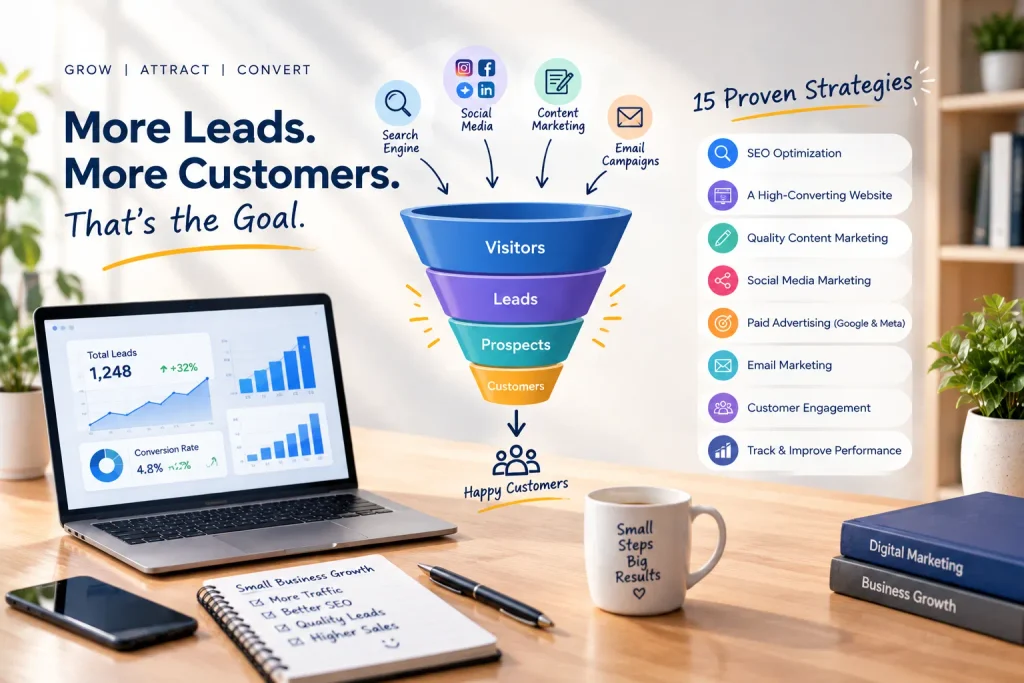
When these channels work together, Lead Generation for Small Businesses becomes far more effective.
How SEO Improves Lead Generation for Small Businesses
According to Google Search Central, businesses should focus on creating helpful, people-first content and maintaining a technically optimized website to improve search visibility.
SEO remains one of the most effective lead-generation channels.
Unlike paid advertising, SEO can continue delivering traffic for months or even years.
SEO Helps By
Targeting High-Intent Searches
People searching on Google often have immediate needs.
Increasing Organic Visibility
Higher rankings lead to more website visits.
Building Authority
Consistent SEO strengthens trust and credibility.
Supporting Long-Term Growth
SEO generates sustainable traffic over time.
Website Optimization Strategies That Increase Leads
Improve Page Speed
Fast websites improve user experience and conversions.
Optimize for Mobile
Mobile users should enjoy the same experience as desktop users.
Create High-Converting Landing Pages
Landing pages should focus on a single goal.
Use Clear CTAs
Every page should encourage action.
Add Trust Elements
Trust improves conversion rates significantly.
How Social Media Marketing Supports Lead Generation
Social media is not just about likes and followers.
Instead, it helps businesses:
- Build awareness
- Engage audiences
- Drive website traffic
- Generate leads
Moreover, consistent social media activity strengthens brand recognition and trust.
How Google Ads Can Generate Faster Leads
SEO takes time.
However, Google Ads can provide immediate visibility.
Benefits include:
Instant Exposure
Your business can appear at the top of search results.
Better Targeting
Reach people actively searching for your services.
Measurable Results
Track clicks, calls, and conversions.
Scalable Growth
Increase investment as performance improves.
Lead Generation Checklist for Small Businesses
Before expecting more leads, make sure your business checks these boxes:
✅ Fast website
✅ Mobile-friendly design
✅ Strong CTAs
✅ SEO optimization
✅ Local SEO strategy
✅ Customer reviews
✅ Google Business Profile
✅ Lead capture forms
✅ Conversion tracking
✅ Content marketing plan
✅ Social media presence
✅ Google Ads strategy
How Bizzdose Helps Small Businesses Generate More Leads
At Bizzdose, we understand that a website should do more than simply exist online.
It should generate business opportunities.
Therefore, our team focuses on strategies that improve Lead Generation for Small Businesses through:
- Website development
- SEO services
- Social media marketing
- Google Ads management
- Content marketing
- Conversion optimization
Businesses looking to strengthen their digital presence can explore the resources available on the Bizzdose Blog and learn more about our approach through Bizzdose Contact Page.
Conclusion
Many small business websites fail because they focus on appearance rather than performance.
However, successful websites are built around one objective: generating customers.
By improving website speed, SEO, mobile experience, trust signals, content quality, and conversion optimization, businesses can dramatically improve their results.
Most importantly, Lead Generation for Small Businesses is not about attracting random traffic. Instead, it is about attracting the right visitors and converting them into paying customers.
If your website is not generating the leads you expect, now is the time to identify the gaps and implement the strategies discussed in this guide.
Frequently Asked Questions
What is lead generation for small businesses?
Lead generation for small businesses is the process of attracting potential customers and encouraging them to take actions such as filling out a form, calling, or requesting a quote.
Why is my website getting traffic but no leads?
Common reasons include weak CTAs, poor user experience, lack of trust signals, and ineffective conversion optimization.
Is SEO important for lead generation?
Yes. SEO helps businesses attract highly targeted visitors who are actively searching for products or services.
How long does SEO take to generate leads?
SEO typically requires several months to build momentum. However, the long-term benefits can be substantial.
Should small businesses invest in Google Ads?
Google Ads can generate leads quickly and works especially well when combined with SEO and conversion-focused landing pages.
What is the most effective lead generation strategy?
The best strategy combines SEO, content marketing, social media marketing, conversion optimization, and paid advertising.
How can Bizzdose help my business generate more leads?
Bizzdose offers website development, SEO, content marketing, social media marketing, and advertising solutions designed to help businesses attract and convert more customers.